

By Vivian Nguyen, SPT (Samuel Merritt University), with Joseph Westlake, PT, DPT, OCS, FAAOMPT
Walk into almost any gym, PT clinic, or home exercise program and you’ll find the same handful of “glute exercises” on repeat: clamshells, banded walks, bridges, maybe a lunge or two. Some of that is good instinct. A lot of it is habit — exercises that get prescribed because they’re familiar, not because they’re the highest-value use of the ten or fifteen minutes someone actually has. That’s the question this post is built around: not whether an exercise works at all, but if you only have a few sets to spend, where should they go?
WHY WE DECIDED TO WRITE THIS
A lot of what shows up in your social media feed about glute training is loud, confident, and not necessarily backed by anything. Joseph Westlake, PT, DPT, OCS, FAAOMPT, says that gap is exactly what motivated this project: “we wanted to come up with content that was backed by research and help our community get to the most direct, high-value information without having to dig too deeply.” It’s also, he points out, muscle groups people don’t always think about, despite their relevance to a number of lower-body injuries. So where does a question like this actually come from? For Vivian Nguyen, SPT, it came straight out of patient care rather than the literature. After working with a wide range of patients, she consistently noticed that people coming in with low back, hip, or knee pain presented with gluteus medius or gluteus maximus weakness. With so many possible exercises and progressions to choose from, “I was most interested in finding the exercises that would elicit the highest muscle activation to optimize patient outcomes,” she says. So the two of them pulled the answer from the EMG (electromyography) literature on gluteus maximus and gluteus medius activation and ranked it by what actually earns its place in a short, focused program.
That time-efficiency question isn’t incidental to how the clinic operates — it’s central to it. “We see clients 45 minutes at a time, which is more than most other health professions, but we are still compressed for time because we also like to include hands-on manual therapy in our practice,” Joseph says. Using high-value, carryover-friendly exercises during the session helps make clients independent with their home program, with confidence that the exercises are firmly within their ability to complete between visits. But if every exercise in a session is competing with hands-on treatment time, which ones actually deserve the slot?
THE REAL STANDARD: WHAT COUNTS AS “WORKING”
Before ranking anything, it helps to know the bar. Across this research, muscle activation is scored as a percentage of MVIC (maximum voluntary isometric contraction) — essentially, how hard the muscle is firing relative to its own maximum effort. The generally accepted threshold for building strength and size is 40–60% MVIC or higher. Below that, an exercise may still have value for balance, motor control, or early-stage rehab, but it isn’t doing much heavy lifting for strength gains. That threshold is the filter for everything below, and it’s also why some long-standing clinic favorites don’t make the cut.
GLUTEUS MAXIMUS: SPEND YOUR TIME HERE
| Exercise | % MVIC | Worth it? | Source |
|---|---|---|---|
| Step-Up* | 169% ± 101% | Yes — top of the list | Neto '20 |
| Lateral Step-Up | 114% ± 55% | Yes | Neto '20 |
| Diagonal Step-Up | 113% ± 44% | Yes | Neto '20 |
| Crossover Step-Up | 104% ± 34% | Yes | Neto '20 |
| Hex Bar Deadlift (traditional) | 88% ± 16% | Yes | Neto '20 |
| Single-Limb Squat | 59% ± 27% | Yes | DiStefano '09 |
| Single-Limb Deadlift | 59% ± 28% | Yes | DiStefano '09 |
| Transverse Lunge | 49% ± 20% | Yes, moderate-high | DiStefano '09 |
| Forward Lunge | 44% ± 23% | Yes, moderate | DiStefano '09 |
| Sideways Lunge | 41% ± 20% | Borderline — fine as variety, not a priority | DiStefano '09 |
Full citations: Neto et al. (2020); DiStefano et al. (2009)
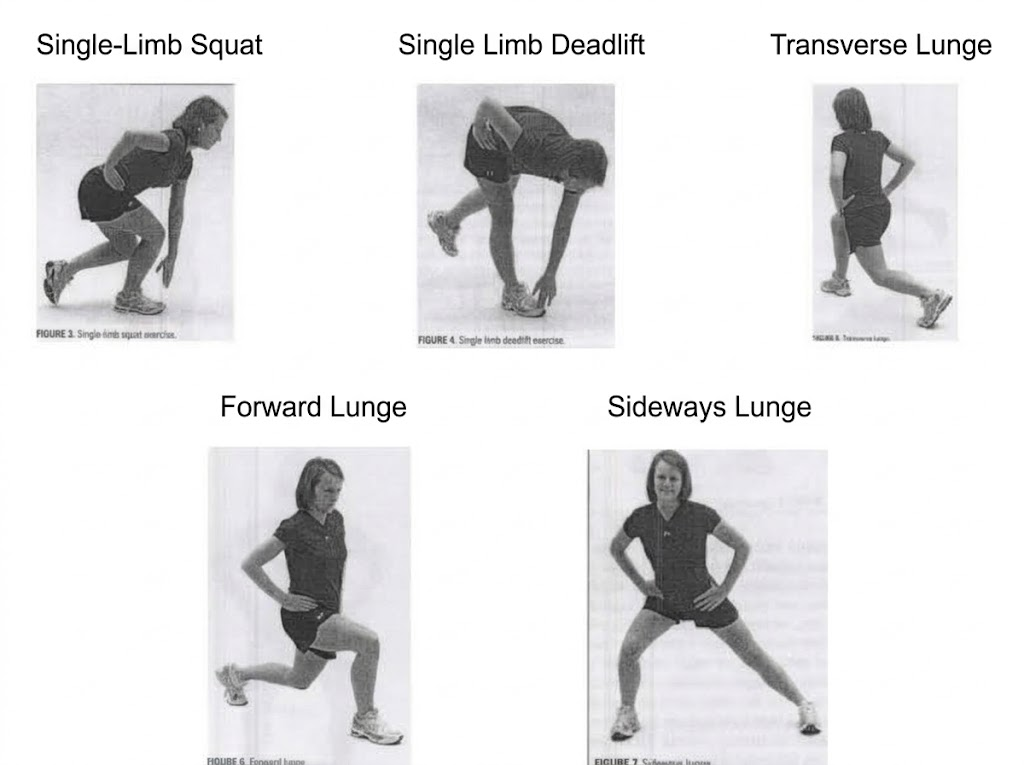
Figures 3–7 from DiStefano et al. (2009): the single-limb squat, single-limb deadlift, and lunge variations used to assess gluteus maximus activation in the table above.
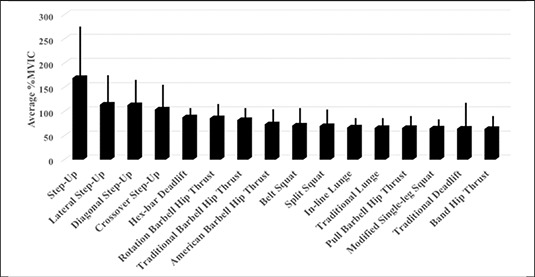
Average %MVIC for gluteus maximus across exercise variants, from Neto et al. (2020). The step-up and its variants top the list, consistent with the table above.
What ties the top of this table together isn’t load — it’s standing on one leg. Comparing the two major studies behind these numbers, Vivian points out that all of the top activation exercises for the gluteus maximus are in single-limb stance: single-limb squat and single-limb deadlift topped the older study, and the newer study was all step-ups, which are still single-leg stance. “Continuing to have that single-leg stance creates the need for pelvic stability, and I think that’s what creates the biggest gluteus maximus activation,” she says. The mechanism makes sense once you break down what single-leg stance actually demands of the body: it requires lumbo-pelvic control, eccentric control of the hip flexor, and concentric control of the hip extensor — all major functions of the gluteus maximus. For athletes specifically, that range of motion isn’t incidental, it’s the point. Joseph explains that the high-MVIC exercises recruiting the most muscle have in common their ability to stretch a muscle through the length-tension relationship and work it through that range — which tracks clinically, since athletes need excellent neuromuscular control and recruitment through a wider range of motion than the general population.
This comes up constantly in clinic. Partway through a lateral step-up, one patient asked Vivian the obvious question: what muscle is working? She explained that it was the gluteus maximus, and that research shows this exercise produces the highest gluteus maximus activation of the options tested. “I gave the analogy that, similar to how everyone would like their doctor to prescribe the best medication for a condition, I’m prescribing one of the best evidence-based exercises, tailored directly to their impairment,” she told the patient.
If you’re short on time: a step-up* — loaded if appropriate, and scaled in height to the person rather than a fixed box — plus one single-limb hinge pattern, either a single-limb deadlift or a hex bar deadlift, covers the top of this entire table in two exercises.
GLUTEUS MEDIUS: SPEND YOUR TIME HERE
| Exercise | % MVIC | Worth it? | Source |
|---|---|---|---|
| Side-Lying Hip Abduction | 81% ± 42% | Yes — top of the list | DiStefano '09 |
| Single-Limb Squat | 64% ± 24% | Yes (double duty with glute max) | DiStefano '09 |
| Lateral Band Walk | 61% ± 34% | Yes | DiStefano '09 |
| Single-Limb Deadlift | 58% ± 25% | Yes (double duty again) | DiStefano '09 |
| Sideways Hop | 57% ± 35% | Yes, for higher-level patients/athletes | DiStefano '09 |
| Lateral Step-Up | 45.0% | Yes (double duty with glute max) | Moore '20 |
| Side-Lying Hip Abduction with Internal Rotation | 44.7% | Yes — and more targeted (see below) | Moore '20 |
| Single-Leg Bridge | 41.3% | Yes, moderate-high | Moore '20 |
| Clamshell | Consistently ranked lowest in both studies tested | No — deprioritize | DiStefano '09 & Moore '20 |
Full citations: DiStefano et al. (2009); Moore, Semciw, & Pizzari (2020)
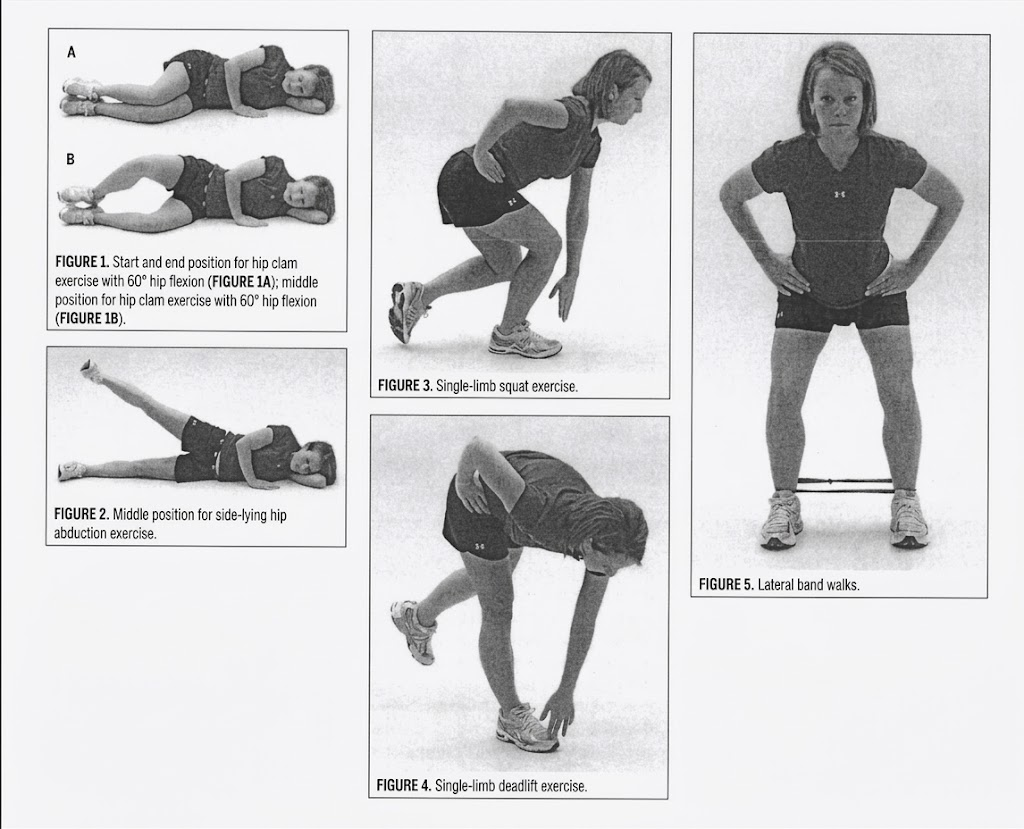
Figures 1–5 from DiStefano et al. (2009): hip clam, side-lying hip abduction, single-limb squat, single-limb deadlift, and lateral band walk exercises used to assess gluteus medius activation in the table above.
Two things are worth noticing here. First, several of the best glute medius exercises — single-limb squat, single-limb deadlift, lateral step-up — are the same exercises that top the glute maximus list, which isn’t a coincidence worth ignoring; it’s efficiency built into the research. Second, the clamshell’s poor showing isn’t a fluke of one study. “Both studies, at the end of their conclusions, said clamshells produced the least gluteus medius activation of the exercises they tested. So I think it’s fair to call that conclusive,” Vivian says — and it’s changed what she actually prescribes, not just what she believes. She’s phased the traditional clamshell out of all her patients’ programming, and now selects the exercises with the greatest muscle activation instead — side-lying hip abduction or single-limb squat — to achieve maximum motor recruitment and restore dynamic pelvic stability.
So why does a seemingly harmless exercise underperform so consistently? It comes down to which muscle is actually doing the work. Vivian’s read is that the clamshell works the tensor fasciae latae (TFL) more than it works the gluteus medius, which also explains why side-lying hip abduction with external rotation produces more TFL and less glute medius activation, while switching to internal rotation shortens the TFL into a more active-insufficient position and works through a lengthened position of the glute medius instead. “That’s what gets you more glute and less TFL,” she says.
That distinction is also where she sees the most promising open question in this research: hip abduction with internal rotation outperforming external rotation on gluteus medius activation is a little counterintuitive, since external rotation is the position that drives more TFL recruitment. She’d like to see more research on gluteal-to-TFL activation ratios specifically, rather than just peak EMG activity in isolation — a distinction that matters most for runners with weak gluteal muscles, who often recruit the TFL as a compensatory strategy to stabilize the pelvis. Understanding those ratios more precisely would allow for more targeted interventions that restore dynamic pelvic stability and reduce the compensatory patterns that can lead to future injury.
If you’re short on time: side-lying hip abduction with internal rotation is the single highest-value, lowest-equipment exercise on this list — no band, no step, no gym required.
HOW WE SUGGEST USING THIS INFORMATION
For clinicians, the two eras of research aren’t competing options, they’re a progression. Vivian treats the older study as the basis for patients who are still early in rebuilding strength, and the newer studies as a source of progression ideas for later phases of rehab — the older research is still highly relevant to the patients she sees, because it doesn’t change how much gluteus maximus and medius activation these exercises generate. The real question driving exercise choice here is simple: is this person ready to add resistance, or still just working on moving well against gravity? Someone who can move against gravity but isn’t yet ready to add resistance isn’t going to be doing a lateral step-up off an 18-inch box, which is much harder to stabilize with more factors involved.
So what do you do with a patient who can’t yet tolerate the standing, higher-demand versions? The fix isn’t to downgrade to a lower-value exercise — it’s to keep the same plane of motion and change the position. Someone who can’t yet move fully against gravity can start lying down instead, in a gravity-eliminated position where the muscle does the same job without fighting gravity, since the research shows that position is still high-value, with the goal of eventually translating that strength into standing. It’s also become a team standard rather than an individual preference — sharing this research across the clinic’s PTs and PTAs keeps exercise prescription consistent for clients across follow-up visits with different providers.
For trainers programming around limited session time, the research makes a fairly direct case for cutting volume rather than adding it. “We don’t have to prescribe as many exercises — we can get straight to the point,” Vivian says. “We can consolidate a plan down to two or three exercises, one for glute medius, one for glute maximus, maybe something for balance, and know that’s a high-value program we can rely on consistently.” A simple starting template, built entirely from the two tables above, looks like one single-limb stance exercise — a step-up, single-limb squat, or single-limb deadlift — which covers both glute max and glute medius at once, paired with one side-lying hip abduction with internal rotation, the single most targeted, equipment-free glute medius movement available, and progressed by step height or load rather than by adding more exercises as the person’s single-limb stability and strength improve. That’s a complete, evidence-backed lower-body glute program in three movements — not because more exercises don’t help, but because these three are doing more work per minute than almost anything else on the list.
For the athlete or patient, if there’s one thing to take from this post, Joseph’s answer is direct: “We want athletes to stop doing clamshells with a band, thinking they’re doing themselves a favor.” More seriously, the goal is to help people gravitate toward high-value exercises for their training, so they don’t feel overwhelmed by what they think they need to do because of external social pressure. A shorter, better-targeted list isn’t a shortcut — it’s the result of actually looking at which exercises earn their place.
THE BOTTOM LINE
Short on time and training glute max? Prioritize single-limb stance work — step-ups, single-limb squats, single-limb deadlifts — over bilateral exercises. Short on time and training glute medius? Side-lying hip abduction, especially with internal rotation, beats almost everything else and needs no equipment. Drop the clamshell if the goal is glute medius strength specifically — it’s not harmful, it’s just not where the activation is. And across the board, two or three exercises, chosen well and progressed consistently, beat a long list done inconsistently, whether you’re a clinician building a plan of care, a trainer programming a session, or a patient trying to stick with a home program.
WHY WE’RE SHARING THIS
Jay West PT takes on physical therapist and physical therapy assistant students each year, and this project is part of why that matters beyond just training the next generation of clinicians. Joseph describes Vivian as an excellent student because she’s hungry for information on how to best help her patients, and capable of comparing her training from school with current evidence to inform her future practice. This project improved on a study the clinic had been using since Joseph was a student himself, and it’s left them with a spectrum of high-value glute exercises usable from early rehab through higher-level functional rehab — exactly how the clinic wants to position itself, as the practice that can take someone from early rehab back to their sport with confidence. Carrying that kind of information forward for the next ten to twenty years of a career is exactly the mindset Joseph wants to develop: “practicing under the mindset of the infinite game — there’s no finish line in this profession, just people who want to keep refining it.”
* Step-up data above comes from a study using an 18-inch box, tested on a female population. Vivian notes that limb length changes how much hip range of motion that step height creates, so scale the step to the person’s own range of motion rather than to a fixed number.
About the research: This post draws on the same body of EMG research Vivian Nguyen reviewed for her clinical in-service at Jay West Physical Therapy: DiStefano et al. (2009), Neto et al. (2020), Moore, Semciw, & Pizzari (2020), and Simenz et al. (2012), among others. The full breakdown — including the complete study tables, reference list, and the clinical discussion behind these numbers — is available in Beyond the Clamshell: What the Research Says About Training Glute Max and Glute Medius.
Image Credits
Figures reproduced from the following studies:
Distefano, L. J., Blackburn, J. T., Marshall, S. W., & Padua, D. A. (2009). Gluteal muscle activation during common therapeutic exercises. The Journal of Orthopaedic and Sports Physical Therapy, 39(7), 532–540. https://doi.org/10.2519/jospt.2009.2796
Neto, W. K., Soares, E. G., Vieira, T. L., Aguiar, R., Chola, T. A., Sampaio, V. L., & Gama, E. F. (2020). Gluteus Maximus Activation during Common Strength and Hypertrophy Exercises: A Systematic Review. Journal of Sports Science & Medicine, 19(1), 195–203.